
If you searched "Polymarket stocks," here's the honest answer up front: Polymarket is not a stock exchange. You can't buy a share of Apple or Tesla there, and there's no "Polymarket stock" to buy either. What you can do - and what most people actually want - is trade prediction markets about the stock market and the economy: where the S&P closes, whether the Fed cuts, recession odds, and more. This guide clears up the confusion and shows you the part that's genuinely useful.
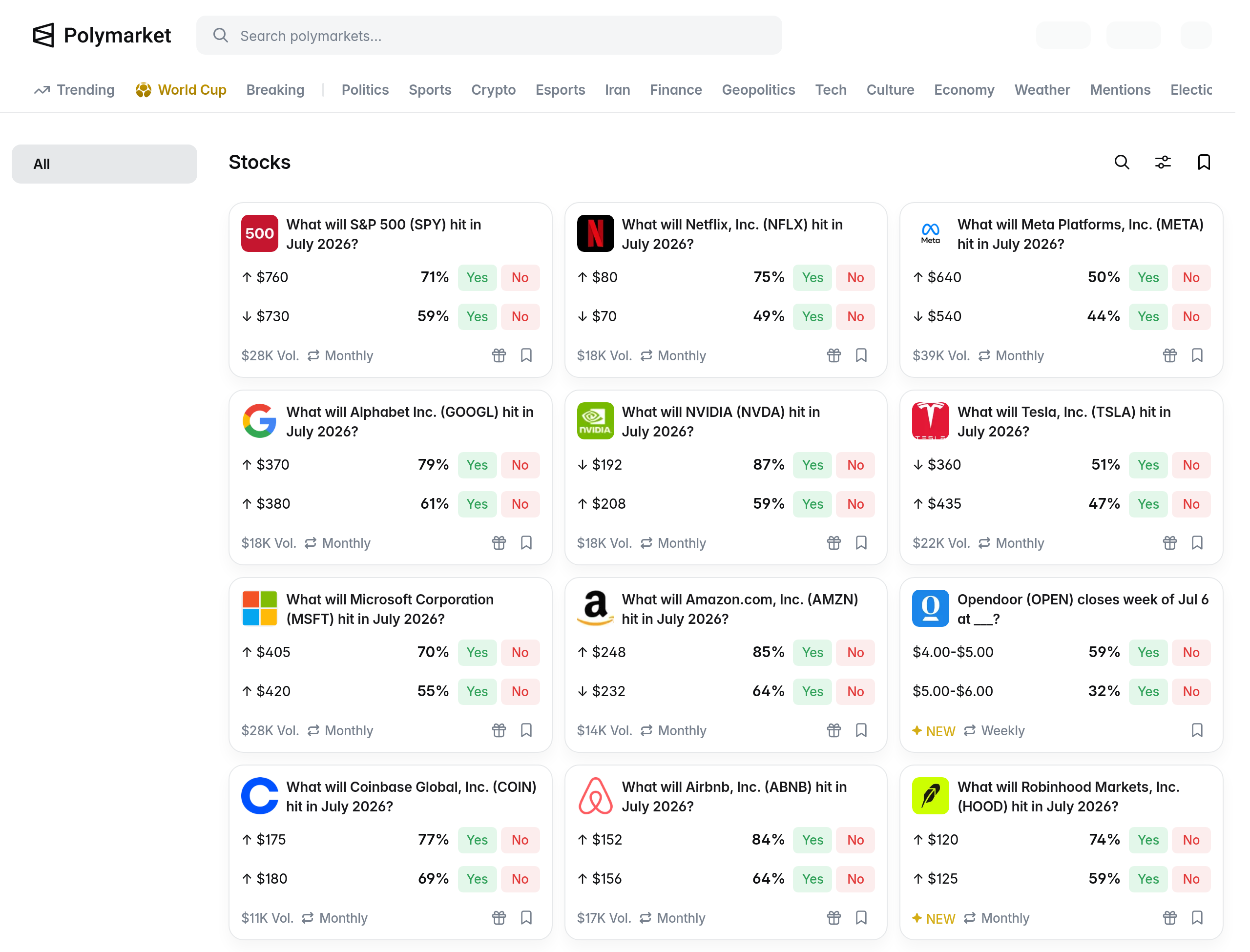
Polymarket's Stocks category: markets like “What will S&P 500 (SPY) hit in July 2026?”, alongside NVIDIA, Tesla and Meta. Each card is a prediction market about a stock's price - you buy Yes or No on a level, you never own the share.
The short version
- No company shares: Polymarket isn't a brokerage - you can't buy Apple/Tesla/etc. there.
- No "Polymarket stock": it's a private company, no ticker, no IPO. "Polymarket shares" ads = scam.
- But yes to the stock market: trade events like S&P levels, Fed decisions, recession odds, "will [stock] hit $X."
- Different instrument: a position pays $1 if the event happens, $0 if not - a time-bound probability, not perpetual ownership.
Polymarket is not a stock broker
Let's kill the misconception first. A stock exchange or brokerage lets you buy a share of a company - a piece of ownership you hold for as long as you like. Polymarket does none of that. It's a prediction market: you buy "shares" of an outcome (Yes or No on a specific question), each worth $1 if it happens and $0 if it doesn't. There's no Apple stock, no Tesla stock, no brokerage account. Confusing the two is the single most common mix-up, so it's worth being clear.
Is there a "Polymarket stock" to buy?
No. Polymarket is a private company - there is no publicly traded "Polymarket stock," no ticker symbol, and no IPO as of 2026. If you see anything advertising "Polymarket shares," a "Polymarket IPO allocation," or a "Polymarket token presale," treat it as a scam. The only thing you ever buy on Polymarket is outcome shares in individual prediction markets, denominated in USDC.
What you CAN do: trade the stock market as events
Here's the useful part. While you can't buy the underlying shares, Polymarket regularly lists markets on stock-market and macro events, and these are some of its most active categories. Common examples:
- Index levels: where the S&P 500 or Nasdaq closes by a date, or whether it crosses a threshold.
- The Fed: will the Federal Reserve cut, hold, or hike at the next meeting; the year-end rate range.
- Macro: recession-by-year odds, inflation (CPI) prints, jobs numbers.
- Single names: "will [company] stock hit $X by [date]," earnings beats/misses.
- Rankings & events: largest company by market cap, notable IPO timing.
Each market shows the crowd's implied probability as a price between $0 and $1. You take a view, buy the side you believe, and can exit at the live price any time before it resolves.
How it differs from owning the stock
| A stock | A Polymarket position | |
|---|---|---|
| What you own | A piece of a company | A claim on a specific outcome |
| Price range | Floats freely | $0 to $1 (a probability) |
| Time | Hold indefinitely | Resolves and ends on a set date |
| Payout | Appreciation / dividends | $1 if the event happens, else $0 |
In short: a stock is open-ended ownership; a Polymarket position is a time-bound bet on a yes/no event. Neither replaces the other - they're tools for different jobs.
How to find stock & economy markets
On Polymarket, browse the Economics, Business or Markets categories, or search the company, index, or event you care about - "S&P," "Fed," "recession," a ticker. Before trading, always read the market's exact resolution criteria: which source counts, on what date, and what threshold defines Yes. The mechanics are the same as any market - non-custodial, on-chain, UMA-resolved - so if you're new, start with the basics.
Getting started
- New here? Check whether Polymarket is legit & safe first.
- Create an account and fund it with USDC.
- Understand the types of markets, then place your first trade.
Want to see the live economy and stock-market markets? Here's the official Polymarket link →