
Short answer: yes, Polymarket is legit - a real prediction-market platform that has operated since 2020 and settled billions of dollars in volume, with trades and payouts recorded transparently on the blockchain. But "legit" deserves an honest breakdown, because how Polymarket keeps your money and resolves markets is genuinely different from a normal betting site. This guide explains exactly how it works, who runs it, where your funds sit, and the risks that are real versus the ones that aren't.
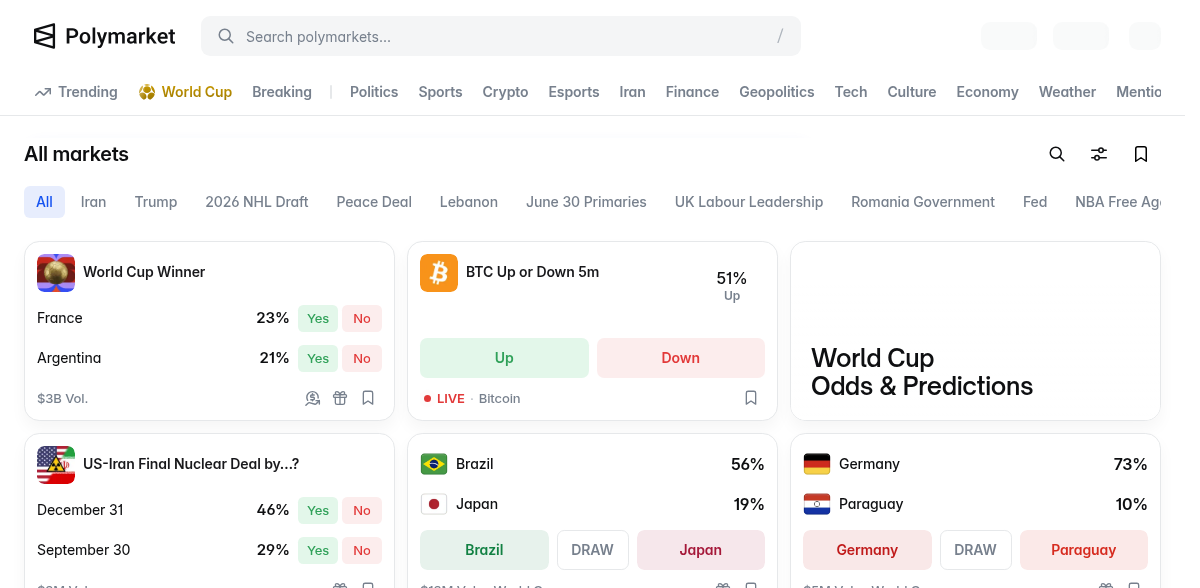
Polymarket's live market board: real events priced in real time, with on-chain volume anyone can verify.
The short version
- Real platform: founded 2020, largest prediction market by volume, runs on the Polygon blockchain.
- Your money is non-custodial: held in a USDC wallet you control - not a Polymarket account they can freeze.
- Transparent resolution: outcomes settled by the decentralized UMA oracle with a public dispute process, not by "the house."
- The real risk is market risk - you can lose a trade. The "they stole my balance" risk of custodial sites doesn't structurally apply.
Is Polymarket a real platform?
Yes. Polymarket launched in 2020 and has grown into the largest prediction market in the world by trading volume, settling billions of dollars across markets on elections, economics, crypto, sports and current events. It isn't a pop-up site: it's a known company with named founders, institutional backing, and years of continuous operation. Every market, trade and payout is recorded on the Polygon blockchain, so the activity is publicly verifiable rather than taking the operator's word for it.
New to prediction markets? Practice everything in this guide with $1,000 in free paper trading first - real Polymarket prices, no card, no risk.
Is it a scam?
No - and the reason is structural, not just reputational. A scam works by taking your deposit and giving nothing back. Polymarket is built so that it can't do that with your balance:
- Self-custody. Your funds sit in a crypto wallet you control, in USDC. Polymarket never holds a balance it could freeze or abscond with. You can withdraw at any time.
- On-chain transparency. Trades, prices and settlements are written to the blockchain, where anyone can audit them. There's no hidden ledger.
- Decentralized resolution. Who wins a market isn't decided by a Polymarket employee - it's decided by the UMA oracle with a public, bonded dispute process.
That combination is the opposite of how a scam is structured. The thing that can cost you money is simple and normal: a trade can lose. That's market risk, and it's true of any market.
Where does my money actually sit?
This is the part people miss. On a custodial betting site or exchange, you deposit into their account and trust them to hold it. On Polymarket, your money stays in a wallet you own, denominated in USDC, a dollar-pegged stablecoin. Polymarket is the venue you trade through, not a vault that holds your cash.
What that means in practice:
- The classic failure mode - "the platform froze withdrawals / ran off with deposits" - doesn't structurally apply, because there's no central pot of your money to run off with.
- The responsibility shifts to you: keep your wallet credentials safe. If you lose your keys or recovery phrase, no support desk can restore them.
- Your dollars are only as stable as USDC, which is a widely-used, reserve-backed stablecoin.
Who's behind it?
Polymarket was founded in 2020 by Shayne Coplan. It's backed by well-known investors, runs on Polygon, and uses the UMA optimistic oracle for resolution. In other words, it's a named, fundable, years-old company - the kind of provenance you'd want to see before trusting a platform with real money.
Is it legal where I live?
This depends entirely on your jurisdiction, and it's the one area where "legit" and "available to you" can differ. Polymarket reached a settlement with the US CFTC in 2022 and restricts access for users in certain regions; some countries block it outright while it's freely accessible in many others. We maintain dedicated, sourced country guides on this - check the one for your location and your local rules before depositing. None of this is legal advice; it's a pointer to do your own check.
How resolution protects you
The fear with any betting venue is "what stops them from just deciding I lost?" On Polymarket, the operator doesn't decide. Markets settle through the UMA optimistic oracle: someone proposes the outcome with a financial bond, there's a window for anyone to challenge it, and genuine disputes escalate to a vote of UMA token holders. Because every step is on-chain and money is staked, twisting a clear-cut result is expensive and visible to everyone. The practical takeaway: read a market's exact resolution criteria before you trade - the rare disputes are about fuzzy wording, not the house cheating.
Using it safely - what's on you
Polymarket being legit doesn't make every trade smart. To use it well:
- Secure your wallet and account; never share your recovery phrase.
- Only deposit what you can afford to lose, in USDC.
- Read each market's rules; understand the real risks before sizing up.
- Start small with your first trade to learn the mechanics.
If you've decided it's for you, here's the official Polymarket link →