
The Short Version
Leverage lets you control a big position with a small deposit. On Polymarket Perps - the leveraged trading product Polymarket opened to early-access users in May 2026 - you can go long or short on BTC, NVDA and gold with multiplied exposure, 24/7, with no expiry date. The launch announcement showed 10x; beta users report leverage selectors going up to 20x on isolated margin. That sounds like free money until you do the math: at 10x, a 10% move against you liquidates the position. At 20x, roughly 5% does. Bitcoin moves 5% on a random Tuesday.
This guide explains exactly what the leverage slider does, how professionals actually use it, the classic ways beginners destroy accounts with it, and every risk you are accepting when you move that slider to the right.
Part 1: What Leverage Actually Is
Leverage is borrowed exposure. When you open a $10,000 BTC long with $1,000 of your own money, you are trading at 10x: your $1,000 is the margin (your skin in the game), and the $10,000 is your exposure (what your profit and loss is calculated on).
If BTC rises 5%, your $10,000 exposure gains $500 - a 50% return on your $1,000 margin. If BTC falls 5%, you lose $500 - half your margin. If it falls about 10%, your margin is gone and the platform closes the position automatically. That forced close is liquidation.

A Long Market order ticket - $500 of margin at 10x leverage opens a $5,000 position. The liquidation price ($6,728.5 here) updates live as you move the leverage slider.
The one table to memorize
| Leverage | Move against you that liquidates | One BTC red day can kill it? |
|---|---|---|
| 2x | ~50% | Essentially never |
| 3x | ~33% | Only in a 2022-style crash |
| 5x | ~20% | Rare - multi-day crash territory |
| 10x | ~10% | A bad week does it |
| 20x | ~5% | Yes. A normal volatile day. |
These are approximations before fees and funding - the exact liquidation price shows on the order ticket before you confirm. The lesson does not change: every step up the slider cuts your survival distance roughly in half.
Part 2: How Polymarket Perps Implement It
- Isolated margin. Each position has its own walled-off margin. If it liquidates, you lose that margin - your other positions and account balance are untouched. You cannot lose more than you committed to the trade.
- No expiry. Unlike event markets that resolve on a date, a perp runs until you close it or it liquidates. There is no resolution day that bails you out.
- Funding rate. A periodic payment between longs and shorts keeps the perp price glued to the real asset price. Reports put Polymarket's funding cap around 11% APR, settling on windows between 5 minutes and 8 hours. It is small per interval but compounds: a leveraged position held for weeks bleeds even when the price goes nowhere.
- 24/7 trading. BTC always trades around the clock; with perps, NVDA and gold do too - including weekends, when liquidity thins and wicks get violent.
- US-regulated venue. Perps run on Polymarket's CFTC-regulated Designated Contract Market - the same legal foundation that lets US users trade at all. Availability still depends on your region and the rollout phase.
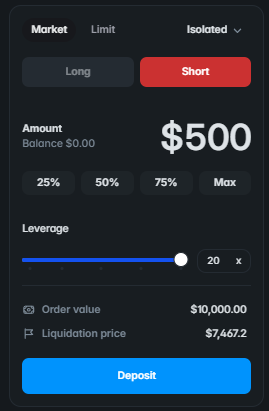
The same ticket switched to Short at 20x: $500 of margin now controls a $10,000 position, and the liquidation price sits only about 5% away - the danger the table above describes.
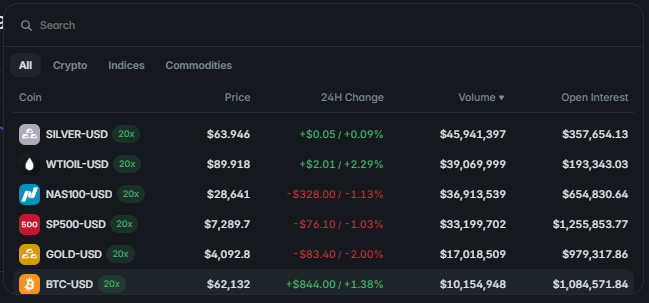
The Perps market list: crypto, indexes and commodities (BTC, gold, oil, S&P 500, Nasdaq) trade around the clock, each with its own leverage cap and open interest.
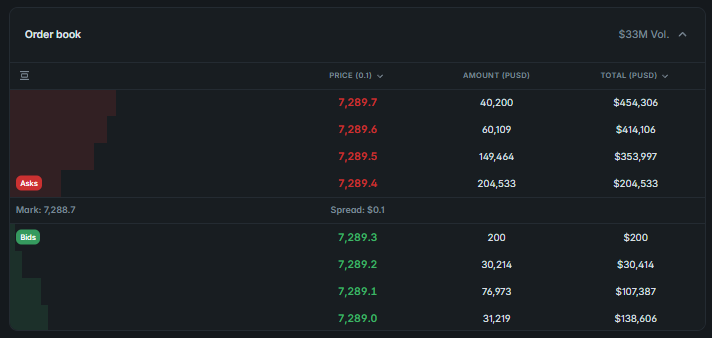
A perp order book: asks (red) rest above the mark price, bids (green) below. The funding rate keeps the perp price tethered to the underlying asset.
Part 3: How to USE Leverage
1. Size the trade by liquidation distance, not by excitement
Before entering, ask one question: "Where is my liquidation price, and is a move there plausible this week?" If BTC is at $100,000 and your liquidation sits at $95,000, you are betting BTC will not see a 5% wick - a bet that loses constantly. Professionals pick the liquidation distance FIRST (say, beyond a major support level), and let that decide the leverage - usually landing at 2-5x.
2. Decide your exit before you enter
Set a take-profit and a stop-loss when you open the position, not after the panic starts. A stop-loss at -3% with 5x leverage means you lose 15% of margin on a bad call - annoying, survivable, repeatable. No stop at 10x means one headline decides your account.
3. Treat margin as money already spent
The margin you commit should be money you are fully prepared to lose - because at high leverage, statistically, sometimes you will. If losing the margin would change your week, the position is too big.
4. Use low leverage for time, high leverage only for moments
The longer you hold, the more volatility you must survive and the more funding you pay. Multi-day swing trade: 2-5x. A quick reaction to a specific event (a Fed decision, an earnings print) where you will close within hours: higher leverage can be rational - with a hard stop.
5. Start with one small position
Your first leveraged trade should be sized so the worst case is a cheap lesson: $20-50 of margin at 2-3x. You are paying for education, not chasing profit. Scale only after you have survived a full win-AND-loss cycle.
Part 4: How NOT to Use Leverage
- Maxing the slider because you are "sure". Certainty is a feeling, not an edge. At 20x you can be right about the destination and still get liquidated by the journey - see the worked example above.
- Trading without a stop-loss. "I'll watch it" fails at 4am. Perps trade 24/7; you do not.
- Adding margin to a losing position. Topping up margin to push the liquidation price away is how a $200 loss becomes a $2,000 loss. If the thesis broke, close the trade. Averaging down on leverage is the single most reliable account destroyer in trading.
- Revenge trading after a liquidation. Doubling leverage to "win it back" is the second most reliable.
- Holding leveraged positions through thin hours. Weekend and overnight wicks hunt exactly where the liquidation clusters sit. If you would not buy the asset at your liquidation price, do not park there.
- Ignoring funding. At ~11% APR cap, funding will not kill you in a day - but a "long-term conviction hold" at 10x pays leveraged funding on the full exposure, week after week.
- Treating perps like event markets. On a Yes/No market your maximum loss is what you paid, and resolution day always comes. A perp has no resolution to save you and liquidation can take 100% of margin early. Different instrument, different rules.
Part 5: The Risks, Named
| Risk | What it does | Your defense |
|---|---|---|
| Liquidation | Forced close, 100% of position margin gone | Low leverage, far liquidation price, stop-loss before it |
| Volatility wicks | A 30-second spike triggers liquidation, then price returns | Liquidation distance beyond obvious support/resistance |
| Funding bleed | Periodic payments drain held positions (capped ~11% APR) | Short holding periods or low leverage for long holds |
| Thin-hours moves | Weekend/overnight gaps on NVDA and gold perps | Reduce size before weekends, avoid parking at high leverage |
| Beta-product risk | Early-access product: rules, fees and limits can change | Small size while the product matures, recheck terms |
| Psychology | Leverage amplifies fear and greed faster than skill grows | Fixed position sizing, journal every trade, no revenge trades |
One risk you do NOT have here: unlike some offshore perp venues, isolated margin means no negative balances and no losing your whole account to one trade - the damage is always capped at the position's margin.
Part 6: Perps or Event Markets - Which Tool When?
Polymarket now offers both, and they answer different questions. An event market is "will X happen by date Y" - your max loss is the price you paid, and time works FOR you as resolution approaches. A perp is "which way does the price go, starting now" - flexible, leveraged, but time works AGAINST you (funding) and the max loss arrives suddenly (liquidation). If your idea has a date and a binary answer, the event market is usually the safer expression. If your idea is purely directional and short-term, that is what perps are for.
Pre-Trade Checklist
- Where exactly is my liquidation price? Is a wick there plausible this week?
- Is my stop-loss set, and does it trigger BEFORE liquidation?
- Is the margin money I can lose without it mattering?
- Do I know my funding cost if this hold runs a week?
- Would the lower-leverage version of this trade still be worth taking? (If not, the trade is the problem, not the leverage.)
What's Next?
- Polymarket Perpetual Futures - Complete Guide - the full product walkthrough
- pUSD Migration Guide - the collateral your margin is held in
- Position Sizing - the math of how much to risk per trade
- Trading Psychology - why leverage breaks discipline first and accounts second
- Risks of Prediction Markets - the wider risk map