
Capitolo 22 di 33
La versione breve
Polymarket ospita 157+ mercati economici attivi che spaziano dalle decisioni sui tassi della Fed (28 mercati), alle letture dell'inflazione (19), alla politica su guerre commerciali e dazi (189 - attualmente la più grande sotto-categoria macro), alle probabilità di recessione, al PIL e all'occupazione. Questi sono i mercati più efficienti della piattaforma, perché i desk macro professionali partecipano attivamente accanto al retail. Quell'efficienza è una caratteristica, non un difetto: la stima di consenso è sempre già prezzata, il che significa che il tuo vantaggio non è mai "indovina il numero" - è prevedere la deviazione dal consenso. Il miglior strumento nel 2026 è il Cleveland Fed Inflation Nowcast, pubblicato ogni giorno alle 10:00 ET, che prevede il CPI con un'accuratezza costantemente migliore dei sondaggi Blue Chip o SPF. Questa guida copre ogni grande mercato economico, il calendario esatto delle uscite, le quattro fonti di dati di nowcasting che producono vantaggio, quattro strategie che funzionano nel 2026 e i pattern specifici di reazione a catena tra i mercati economici e il resto di Polymarket.
- Ogni tipo principale di mercato economico con il prezzo attuale di aprile 2026
- Le fonti di dati che usano i professionisti: nowcast della Cleveland Fed, Atlanta Fed GDPNow, CME FedWatch, calendario BLS
- Quattro strategie: posizionamento pre-uscita, trend post-uscita, correlazione cross-market e approccio alla scadenza
- Il calendario esatto delle uscite per il 2026 - NFP, CPI, FOMC, PIL, PCE
- Perché i mercati sui dazi sono la categoria macro a più alto volume in questo momento
- Quando NON tradare - le due finestre che perdono denaro in modo affidabile

Un mercato Polymarket sulla decisione dei tassi della Fed ("Fed Decision in July?"): l'esito del FOMC è quotato in fasce mutuamente esclusive - nessuna variazione, taglio di 25 pb, rialzo di 25 pb, 50+ pb - ciascuna una propria riga Sì/No. La fascia dominante è la previsione implicita del mercato sulla riunione.
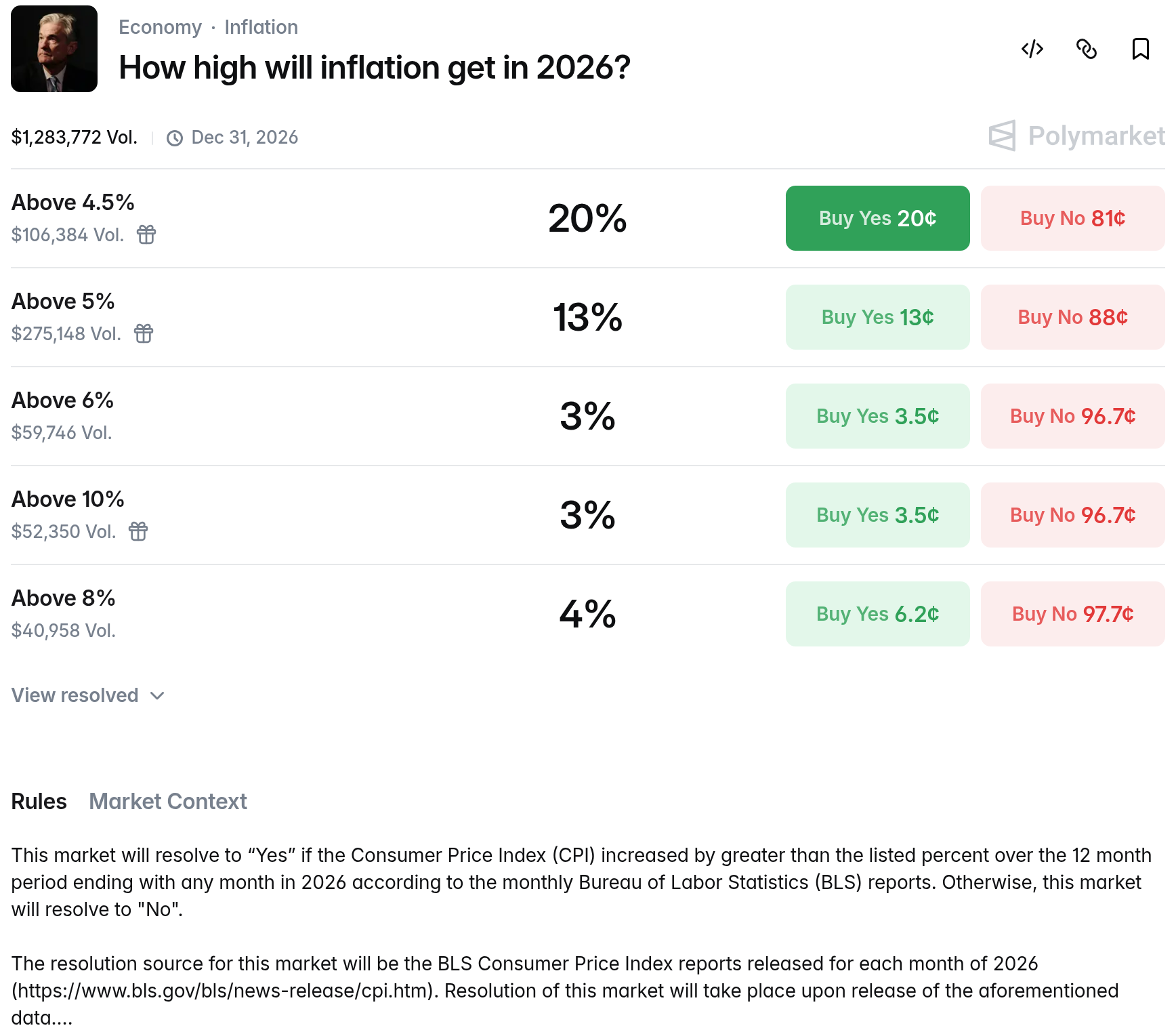
Un mercato Polymarket sulla soglia d'inflazione ("How high will inflation get in 2026?"): ogni livello del CPI - sopra il 4,5%, 5%, 6%, 8%, 10% - è una propria riga Sì/No, così la scala dei prezzi riflette la distribuzione completa del mercato per l'inflazione 2026. Si risolve tramite l'indice dei prezzi al consumo ufficiale della BLS.
Parte 1 - Il panorama dei mercati economici (aprile 2026)
Decisioni sui tassi della Fed
Mercati di decisione per riunione per ogni riunione FOMC del 2026 (29 aprile, 17 giugno, 29 luglio, 16 settembre, 28 ottobre, 9 dicembre) più mercati aggregati come "Quanti tagli nel 2026?" e "Tasso di fine 2026?"
| Mercato | Prezzo attuale | Probabilità implicita |
|---|---|---|
| FOMC 29 aprile: nessun cambio (3,50-3,75%) | 99,4¢ | 99,4% |
| FOMC 17 giugno: nessun cambio | 92,5¢ | 92,5% |
| Tagli totali dei tassi 2026: zero | 34,3¢ | 34,3% |
| Tagli totali dei tassi 2026: uno | 29,5¢ | 29,5% |
| Tagli totali dei tassi 2026: due | 18,1¢ | 18,1% |
| Tasso di fine 2026: 3,25-3,50% | 31,8¢ | 31,8% |
La mediana del dot plot della Fed dal SEP di marzo 2026 è un singolo taglio di 25 pb entro fine anno al 3,4%. Polymarket è leggermente più dovish del dot plot (implicando più tagli) - una tipica inclinazione della folla retail.
Mercati sull'inflazione
I mercati CPI, PCE e a soglia dominano il trading sull'inflazione. Il CPI di marzo 2026 è arrivato al 3,3% su base annua (in aumento dal 2,4% di febbraio), guidato principalmente dal picco energetico del conflitto con l'Iran di aprile 2026. Questo ha colto il mercato impreparato - il nowcast della Cleveland Fed era stato attorno al 2,6% fino a quando il conflitto con l'Iran è scoppiato.
- Letture mensili del CPI (mercati a soglia a incrementi dello 0,1%)
- CPI annualizzato di fine 2026
- PCE core vs headline
- CPI trimmed-mean e mediano dalle Fed regionali
Mercati sulla recessione
"Recessione USA entro fine 2026" attualmente al 25,5% di probabilità (74,5% nessuna recessione). La risoluzione è due trimestri consecutivi di crescita reale del PIL negativa OPPURE un annuncio ufficiale del NBER.
- Recessione di fine anno: 25,5¢
- Recessione che inizia nel 2° trimestre 2026: 11,8¢
- Recessione che inizia nel 3° trimestre 2026: 14,2¢
- Recessione che inizia nel 4° trimestre 2026: 18,9¢
Mercati su guerre commerciali / dazi
Parte 2 - Fonti di risoluzione e calendario delle uscite
| Tipo di mercato | Fonte ufficiale | Giorno / orario di uscita | Finestra di prezzo |
|---|---|---|---|
| Decisione della Fed | Dichiarazione FOMC della Federal Reserve | Mer 14:00 ET (8 riunioni/anno) | 2-4 settimane prima |
| Conferenza stampa del presidente Fed | Conferenza stampa FOMC | 14:30 ET lo stesso giorno della decisione | Prezzato durante la conferenza |
| CPI | BLS | 8:30 ET, ~12-14 giorni dopo il riferimento | 3-5 giorni prima |
| PCE | BEA | Ultimo venerdì del mese | 2-3 giorni prima |
| PIL (advance/prelim/final) | BEA | ~30/60/90 giorni dopo il trimestre | 5-7 giorni prima |
| Non-Farm Payrolls | BLS Employment Situation | Primo venerdì 8:30 ET | 2-3 giorni prima |
| JOLTS | BLS | ~6 settimane dopo il riferimento | 1-2 giorni prima |
| Recessione | Due trimestri di PIL negativo o NBER | Variabile (il NBER è in ritardo di 6-18 mesi) | Continua |
Parte 3 - Fonti di dati che producono vantaggio
Il Cleveland Fed Inflation Nowcast (LO strumento)
Altre fonti primarie
- Atlanta Fed GDPNow - modello PIL in tempo reale aggiornato più volte a settimana. Batte i previsori professionali sull'orizzonte di 2-4 settimane.
- CME FedWatch - probabilità implicite dai futures sui fed funds. Confronta direttamente con Polymarket - se divergono di 5+ punti, c'è un arbitraggio pulito.
- Calendario delle uscite BLS (bls.gov/schedule/) - calendario 2026 completo per CPI, occupazione, PPI, PPI servizi.
- Calendario delle uscite BEA - PIL, PCE, reddito personale.
- Federal Reserve - calendario FOMC, dot plot (SEP), minute post-riunione.
- Richieste (disoccupazione) - rilasciate ogni giovedì alle 8:30 ET, utile indicatore anticipatore per l'NFP.
Fonti secondarie
- Bloomberg Terminal (se hai accesso) - stime di consenso, whisper number
- ForexLive - copertura gratuita in tempo reale di ogni uscita economica
- Blog Calculated Risk - contesto per ogni grande uscita
- Twitter/X - economisti come @NickTimiraos (osservazione della Fed), @ernietedeschi, @gjtedrow
Parte 4 - Quattro strategie che funzionano ancora nel 2026
Strategia 1: Posizionamento pre-uscita basato sulla divergenza del nowcast
- Ogni mattina alle 10:00 ET, controlla il nowcast della Cleveland Fed
- Confronta con l'ultimo consenso Bloomberg/Reuters
- Se il nowcast diverge dello 0,2% o più, scansiona i mercati a soglia sull'inflazione su Polymarket
- Cerca i mercati prezzati contro il consenso invece che contro il nowcast
- Entra 2-4 giorni prima dell'uscita, scala fuori dopo l'uscita
Strategia 2: Trading di trend post-uscita
I primi 5 minuti dopo una grande uscita sono caotici e costosi da tradare. Ma la finestra di 30 minuti dopo il picco iniziale mostra spesso un trend pulito mentre il mercato digerisce il dettaglio completo dell'uscita (core vs headline, direzione della sorpresa, revisioni).
- Aspetta 5-10 minuti per il picco iniziale e l'inversione
- Valuta: il consenso ha corrisposto, battuto o mancato? Direzione della sorpresa?
- Entra nella direzione della sorpresa con stop stretti
- Esci entro 60-90 minuti man mano che il movimento si completa
Strategia 3: Trading di correlazione cross-market
I dati economici innescano reazioni a catena tra le categorie di Polymarket. I trader che capiscono queste correlazioni possono prendere posizioni multi-mercato che dominano i trade ingenui su singolo mercato.
| Catalizzatore | Effetto primario | Effetti secondari su Polymarket |
|---|---|---|
| CPI caldo (0,3%+ sopra il consenso) | Le probabilità di taglio dei tassi della Fed scendono di 8-15 punti | Probabilità di recessione su, mercati dell'oro su, approvazione di Trump giù |
| NFP debole (100K+ sotto il consenso) | Probabilità di recessione su di 4-8 punti | Probabilità di taglio dei tassi su, i mercati sugli asset di rischio vendono, l'approvazione politica scende |
| Annuncio sui dazi | Le aspettative di inflazione salgono di 2-6 punti | I mercati CPI si riprezzano al rialzo, recessione su, le probabilità degli accordi tra paesi cambiano |
| Shock geopolitico (conflitto con l'Iran aprile 2026) | CPI guidato dall'energia su; il CPI è saltato dal 2,4% al 3,3% | I mercati sul cessate il fuoco in Medio Oriente si riprezzano, tagli della Fed ritardati, recessione su |
| Conferenza stampa dovish della Fed | Le probabilità di taglio dei tassi su di 5-10 punti | Recessione giù, risk-on, approvazione di Trump leggermente su |
Strategia 4: Approccio alla scadenza (mercati sui dazi)
Molti mercati sui dazi hanno scadenze precise: "Trump rimuoverà i dazi prima che scada la pausa di 90 giorni?" Man mano che la scadenza si avvicina senza azione, i contratti No si apprezzano in modo affidabile. Questo è un vantaggio strutturale e ripetibile nei mercati di policy a tempo determinato. Il pattern del 2026 è stato il 60-70% dei mercati sui dazi "azione prima della scadenza" che si risolvono No.
- Identifica i mercati di policy a tempo determinato con 10+ giorni alla scadenza
- Filtra per prezzi Sì sopra 25¢ (il lato No è sottoprezzato)
- Compra No, tieni finché la scadenza si avvicina
- Scala fuori man mano che la probabilità scende sotto 15¢ - non cavalcare fino a zero, c'è sempre un rischio di coda
Parte 5 - La tempistica dei tuoi trade
Eventi ad alto impatto (eventi rossi nella maggior parte dei calendari)
Questi creano i movimenti di mercato più grandi - oscillazioni del 10-15% sono possibili sui mercati pertinenti:
- Non-Farm Payrolls - Primo venerdì di ogni mese, 8:30 ET
- CPI - Mensile, 8:30 ET, ~12-14 giorni dopo il mese di riferimento
- Decisione FOMC + conferenza stampa - 14:00/14:30 ET, 8 riunioni all'anno
- PIL Advance - Trimestrale, ~30 giorni dopo la fine del trimestre
- PCE - Ultimo venerdì del mese, 8:30 ET
Quando NON tradare
- 2-3 giorni prima di una grande uscita - la liquidità si assottiglia mentre i trader riducono il rischio, gli spread si allargano drasticamente, e paghi più in slippage di quanto guadagni in posizione
- Primi 5 minuti dopo un'uscita - azione di prezzo caotica a doppio senso, gli order book vengono fatti a pezzi, lo slippage può essere 5-10x il normale
Parte 6 - Rischi specifici dell'economia
| Rischio | Gravità | Mitigazione |
|---|---|---|
| Consenso già prezzato | Alta | Tradai solo quando hai una visione differenziata - divergenza del nowcast, non solo avere un'opinione |
| Revisioni dei dati | Media | Controlla le regole del mercato - la risoluzione usa di solito l'uscita iniziale, ma conferma |
| Posizioni correlate | Media | Tre mercati CPI sono di fatto una scommessa - dimensiona di conseguenza |
| Interferenza politica (dazi) | Alta | Dimensiona i mercati sui dazi in modo conservativo; assumi che esiti irrazionali siano possibili |
| Errore di comunicazione della Fed | Bassa | La Fed raramente sorprende sulla decisione stessa; le sorprese arrivano nelle conferenze stampa e nel SEP |
| Modalità di fallimento del nowcast | Bassa - Media | Il nowcast si rompe durante gli shock di offerta (es. conflitto con l'Iran aprile 2026) |
| Evento macro cigno nero | Media | Tieni polvere da sparo - l'opportunità appare spesso 24-48h dopo uno shock |
Parte 7 - Un flusso di lavoro pro per il trading economico
- Costruisci un calendario delle uscite - segna ogni data di CPI, NFP, FOMC, PCE, PIL per l'anno
- Controlla il nowcast della Cleveland Fed ogni giorno alle 10:00 ET - è gratis, è migliore del consenso Bloomberg, usalo
- Confronta con CME FedWatch prima di entrare nei mercati Fed - l'arbitraggio cross-platform è spesso di 5-10 punti
- Filtra per divergenza - consenso vs nowcast, Polymarket vs futures fed, aspettative vs realtà
- Entra 3-7 giorni prima delle uscite - la liquidità è migliore, il prezzo non è ancora del tutto convergito
- Usa ordini limite - le commissioni sui mercati economici sono dell'1,25% di taker di picco, 0% maker
- Dimensiona con quarter-Kelly - vedi dimensionamento della posizione
- Evita di tradare 2-3 giorni prima delle grandi uscite - liquidità troppo sottile
- Non tradare i primi 5 minuti dopo l'uscita - aspetta che il picco si schiarisca
- Traccia le reazioni a catena - le sorprese sul CPI influenzano recessione, Fed, approvazione politica e mercati commerciali contemporaneamente
Parte 8 - Consigli pro validati per i mercati economici
- Alle 10:00 ET ogni giorno di trading - apri la pagina del Cleveland Fed Inflation Nowcast. Trenta secondi. È la singola abitudine a più alto ROI sulla macro di Polymarket.
- Scrivi il consenso prima di guardare il mercato - evita di ancorarti al prezzo attuale. La tua visione vs il consenso è il trade; il prezzo di mercato è l'esecuzione.
- Tradai solo la divergenza, non la direzione - se nowcast e consenso concordano, il trade è già prezzato. Saltalo e aspetta il prossimo dato.
- Verifica CME FedWatch su ogni mercato Fed - se Polymarket e i futures sui fed funds non concordano di 5+ punti, hai un arbitraggio su due sedi per la dimensione che riesci a sopportare.
- Dimensiona i mercati sui dazi a metà della tua dimensione normale - l'irrazionalità politica è il più grande driver di perdita macro dell'anno. Assumi che l'esito peggiore sia possibile, non quello modale.
- Non tradare mai i primi 5 minuti post-uscita - spread 5-10x il normale, liquidità sparita, frusta a doppio senso. Aspetta la finestra di pulizia.
- Entra 3-7 giorni prima delle uscite, esci verso l'uscita - la convergenza pre-uscita è la parte più pulita della curva. Non provare a tradare il dato stesso.
- Usa maker limite su tutto - 0% di commissione maker + rebate di liquidità vs 1,25% taker. Su 200 trade all'anno quel divario è l'1-2% del bankroll, che è il vantaggio della maggior parte delle persone.
- Traccia le reazioni a catena esplicitamente - una sorpresa sul CPI non muove solo i mercati sull'inflazione; muove Fed, recessione, approvazione, oro e mercati sugli accordi tra paesi. Imposta avvisi pre-uscita su tutti e cinque.
- Tieni polvere da sparo per gli shock - il conflitto con l'Iran di aprile 2026 ha prodotto la più grande rivalutazione macro in un singolo giorno nella storia di Polymarket. I trader con il 20% di liquidità di riserva hanno catturato 3-5x R. I trader che erano all-in hanno mangiato la volatilità.
- Rispetta le revisioni - il BLS ha rivisto al ribasso l'NFP di febbraio 2026 di 68K un mese dopo l'uscita. I mercati che si erano già risolti non sono stati colpiti; i mercati che non si erano ancora risolti a volte si sono riprezzati violentemente. Controlla le regole di risoluzione su ogni trade.
- Quarter-Kelly massimo - anche con un vantaggio genuino, le uscite macro sono binarie e fat-tailed. Il quarter-Kelly con una lettura di confidenza del 55% ti tiene in gioco attraverso gli inevitabili 3-4 perdenti di fila.
| Situazione | Mossa professionale |
|---|---|
| Il nowcast diverge dello 0,2%+ dal consenso | Costruisci la posizione 3-7 giorni prima, maker limite, dimensiona al quarter-Kelly pieno |
| CME FedWatch 5+ pt sopra Polymarket | Compra il lato più economico su Polymarket, dimensiona all'arbitraggio, tieni fino alla risoluzione |
| Primi 5 min dopo una grande uscita | Mani via. Osserva la frusta, dimensiona nulla. Rientra nella finestra di pulizia. |
| Scadenza dei dazi entro 10 giorni, Sì > 25¢ | Vendi Sì / compra No; scala fuori man mano che la probabilità scende sotto 15¢ |
| Shock di offerta (petrolio, guerra, meteo) | Il nowcast si rompe; allarga la tua banda di confidenza; aspetta la prossima uscita |
| La conferenza stampa della Fed contraddice il tono della dichiarazione | Fai il fade della reazione iniziale dopo 5 min; il trend dei successivi 60-90 min è di solito quello corretto |
| NFP 100K+ sotto il consenso | Mercati sulla recessione su di 4-8 pt, probabilità di taglio dei tassi su di 5-10 pt; pre-predisponi tutti e cinque i mercati della reazione a catena prima del dato |
Punto chiave
I mercati economici (Fed, CPI, GDP) premiano chi legge il calendario ufficiale dei dati e la fonte di risoluzione: il dato che fa settlare il mercato è quello indicato nella guida, non il titolo della notizia.
Cosa viene dopo?
I mercati economici sono i più efficienti su Polymarket, il che significa che sono anche i più onesti - il tuo vantaggio deve essere reale. La buona notizia è che il vantaggio è disponibile: il solo nowcast della Cleveland Fed produce 3-5 trade ad alta convinzione al mese se sei paziente. Combinalo con puliti trade di correlazione cross-market e hai una genuina sotto-strategia macro che non richiede alcun accesso a terminali specializzati.
Prossimi passi: trading di geopolitica, strategie avanzate e mercati multi-esito (NegRisk).
Lettura consigliata
Inizia da qui se sei nuovo, o salta direttamente alla pagina che corrisponde alla tua fase: