A federal judge in Chicago handed the biggest prediction-market operators a win on October 2, 2026, and in doing so pulled the US courts further apart over a question worth billions in trading volume: are contracts on who wins a game a federally regulated financial instrument, or unlawful sports gaming under state law? US District Judge Martha M. Pacold granted Kalshi, Coinbase and the Commodity Futures Trading Commission (the federal regulator of derivatives) a partial injunction blocking Illinois from applying its licensing rules to certain sports event contracts, finding the platforms likely to win their argument that the contracts are "swaps" under federal law.
The ruling matters well beyond Illinois. It deepened a split among the federal appeals courts that the Supreme Court, just one day earlier, declined to step into, leaving the legality of a fast-growing market to be decided state by state, district by district. For traders on Polymarket, Kalshi and Coinbase, including the Israeli crypto and derivatives readers who follow these platforms closely, the practical answer to "can I legally hold this contract?" now depends on which state's map you are standing on.

Inside the Illinois ruling
Pacold, who sits in the Northern District of Illinois, framed the dispute in unusually plain terms. "Many of the financial instruments at issue are likely swaps as defined by the Commodity Exchange Act," she wrote, "they just happen to be swaps that people find entertaining and fun." The case, Coinbase Financial Markets v. Raoul, pitted the exchanges and Coinbase's CFTC-registered trading arm against Illinois Attorney General Kwame Raoul, who had sought to regulate the contracts under state licensing law.
The win was partial, not total. The court did not decide whether Illinois's tax and fee provisions on the contracts are also preempted by federal law, reserving that question for further argument, with an agreed proposed injunction expected around October 29, 2026. Molly Abraham, Coinbase's general counsel, called the decision "an important step toward preserving the CFTC's role in overseeing these national markets and ensuring Illinois consumers can continue to access them."
Swap or gaming: the question underneath
The entire fight turns on one classification. The Commodity Exchange Act, the federal statute that defines "swaps" and hands the CFTC exclusive jurisdiction over them, is the platforms' shield: if a sports event contract is a swap, they argue, only Washington can regulate it, and conflicting state gaming laws are preempted. The states counter that a contract paying out on whether a team wins is unlawful gaming dressed as a derivative, and therefore squarely within their power to license, tax or prohibit.
This is not gambling in the casino sense, the platforms insist, but a position in a federally regulated market, priced and cleared like other derivatives. The states insist the opposite. No court has found a middle path, and that binary, swap or gaming, is exactly what has produced irreconcilable rulings.
A losing streak, reversed
Until October 2, the platforms had been losing. On September 25, 2026, the Sixth Circuit ruled against Kalshi in a case brought by Ohio and Tennessee, holding that its sports event contracts are not swaps and that the Commodity Exchange Act likely does not preempt state gaming law. A month earlier, on August 28, the Ninth Circuit sided with the Nevada Gaming Control Board against Robinhood's and Kalshi's sports contracts. Both courts, in effect, treated them as gaming.
The outlier had been the Third Circuit, which on April 6, 2026 affirmed a preliminary injunction for Kalshi against New Jersey by a 2-1 vote, accepting the swap reading and that the federal law governs. The Illinois decision did more than add to that appellate disagreement: it opened a split inside a single circuit. "Friday's ruling means there's an intracircuit split at the Seventh Circuit due to the earlier ruling in the Wisconsin district court," said Gary Kalbaugh, a derivatives partner at the law firm Cahill Gordon & Reindel, pointing to a Wisconsin federal judge who had let that state treat the contracts as gaming.
The Supreme Court stays on the sidelines
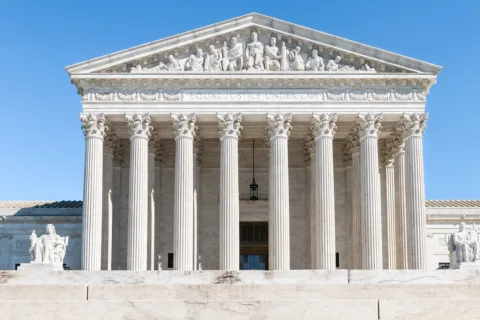
The one court that could end the confusion just signaled it is in no hurry. On October 1, 2026, the first day of its new term, the Supreme Court released its opening order list, granting review in three unrelated cases and passing over every pending prediction-market petition. Two are squarely before the justices: New Jersey's petition in Flaherty v. KalshiEX (No. 26-299), filed September 2, and Robinhood Derivatives' petition against Nevada (No. 26-338).
Even if the court eventually takes the case, the calendar is slow. Kalshi's response to New Jersey was extended to November 9, 2026, and Nevada's response to Robinhood is due October 14, meaning the justices cannot even consider the petitions together for weeks. The court could also ask the US Solicitor General, D. John Sauer, for the federal government's view first, adding months. Some lawyers tracking the cases say a merits decision might not land until 2028.
They also think it is coming. "It's a statutory interpretation question, particularly in the question of field preemption," said Dan Boyle, a commercial litigation attorney at Boies Schiller Flexner. "I think the Supreme Court's going to see the importance of addressing this, what is now a clear circuit split."
The states are not waiting
While the federal question sits unresolved, state regulators are moving on their own. On October 2, the same day as the Illinois ruling, the Ohio Casino Control Commission (the state's gaming regulator) sent cease-and-desist notices to 10 prediction-market operators and brokers, among them Polymarket, Coinbase and Robinhood Derivatives, ordering them to stop offering sports event contracts by October 16, 2026. Notably, Kalshi was not on the Ohio list.
Michigan has gone further. A state-court injunction out of Ingham County, won by Attorney General Dana Nessel, keeps Kalshi blocked from offering sports contracts there and is backed by a penalty of $500,000 per day for violations, after a June temporary order was converted into a fuller one on September 2. For Polymarket, the crypto-native exchange that gives this site its name, the Ohio order is a reminder that a CFTC argument winning in Chicago does not shield it from a regulator in Columbus.
What it means for the people trading
Behind the filings sits an unusual regulator. The CFTC is currently run by a single sitting member, Chairman Michael Selig, and over the summer he advanced a rulemaking (amendments to Rule 40.11, with a new Appendix F) that would let most sports event contracts now on offer continue. That puts the agency's own direction at odds with the state courts ruling the contracts illegal, and it is part of why the law firms watching the cases describe the landscape as unstable.
"Until the Supreme Court rules, and with the CFTC continuing to advance its position, this checkerboard approach of where prediction markets can operate and not operate under the various court decisions, it's going to be very uneven and that's not good for anybody," said Adrian King, who co-leads the gaming and state attorneys general teams at the law firm Ballard Spahr. For a trader, the upshot is concrete: the same sports event contract can be legal to hold in one state and barred in the next, and the line can move with a single district-court order.
 ICE18%AnoNe
 ForecastEx13%AnoNe
For the first time, the legal status of a US prediction-market contract depends less on what the contract is than on where its holder happens to be. The same line on the same game is a federally regulated swap in New Jersey and Illinois and unlawful gaming in Ohio, Nevada and Tennessee, where Michigan alone threatens Kalshi with $500,000 a day and the Ohio Casino Control Commission set an October 16, 2026 shutoff. Neither the Supreme Court, which passed on the petitions October 1, nor Chairman Michael Selig's single-member CFTC is positioned to erase that line soon. Until one of them does, Kalshi, Coinbase and Polymarket are not building a single US market. They are building fifty.