
Esports is one of Polymarket's most active sports categories - and right now it is peaking, because The International, Dota 2's world championship, is live. Individual matches there clear seven figures in 24-hour volume. This guide covers what esports markets Polymarket actually has, the four ways you can trade them, how they resolve, and where a knowledgeable trader still finds an edge that the bots have stripped out of other categories.
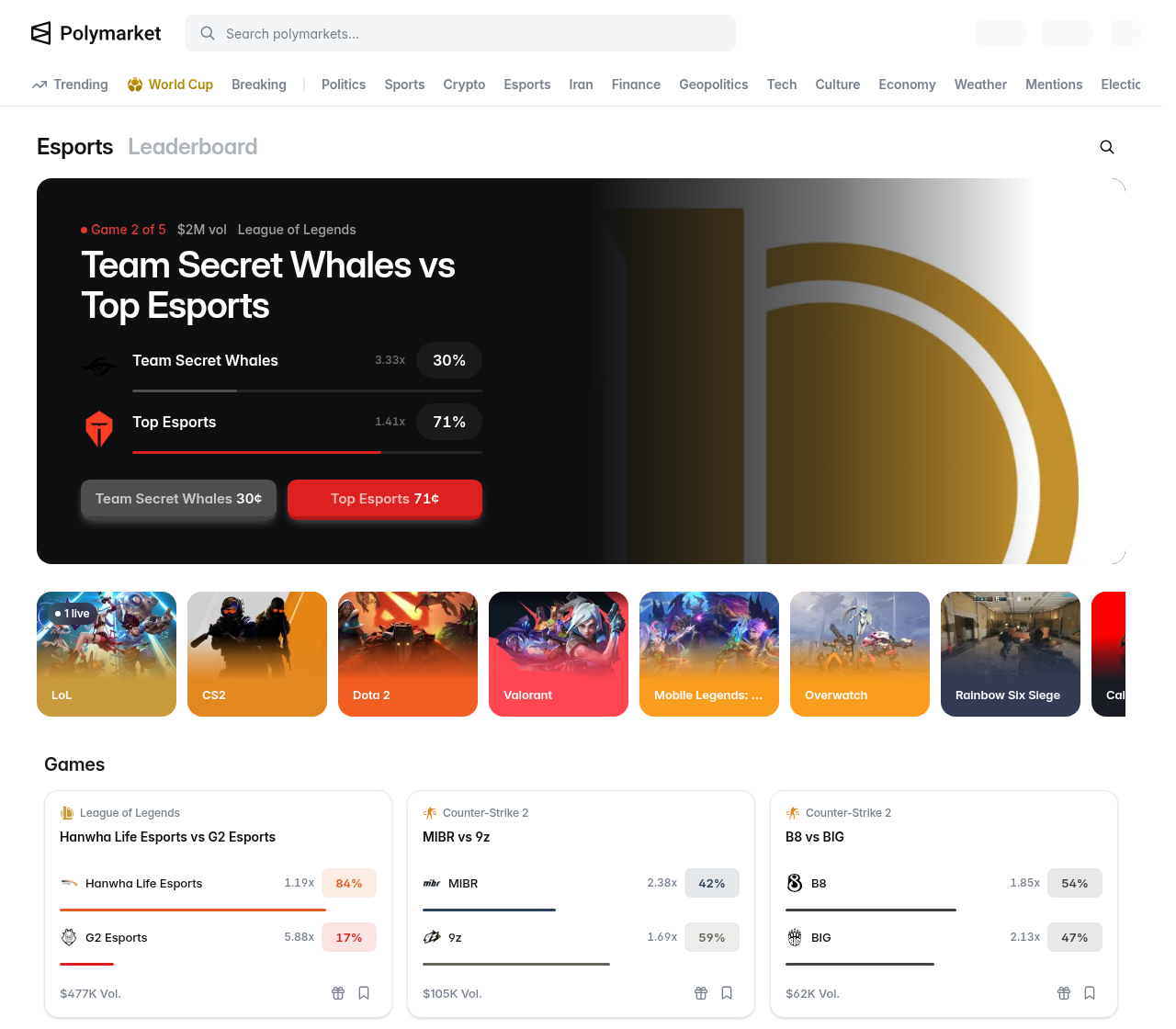
The live Esports category on Polymarket: a featured match up top, game filters (LoL, CS2, Dota 2, Valorant and more), then head-to-head match markets - each team priced by its win probability, with real trading volume.
The short version
- Biggest games: Dota 2 (The International), League of Legends (LPL, LCK, Worlds), Counter-Strike 2.
- Four market types: match winners, tournament/season winners, meta/map markets, player props.
- Resolution: UMA oracle on the official result - objective for matches, read the text on meta markets.
- Edge survives here (unlike 5-minute crypto): regional bias, patch shifts, live in-series moves. Liquidity is deep only on marquee events.
What esports Polymarket has
Polymarket's esports coverage concentrates on the games with the largest global audiences:
- Dota 2 - including The International, the marquee event, plus regular-season and tournament matches. This is where the deepest liquidity lives; a single best-of-three can clear over $1M in 24-hour volume during TI.
- League of Legends - the Chinese LPL, the Korean LCK, and the Worlds championship ("Worlds 2026 Winning Region"). Season-winner markets run all year.
- Counter-Strike 2 - individual matches plus distinctive meta markets like whether Valve adds or removes a map from the active pool by a date.
- Call of Duty League (CDL) and a long tail of player/org props - retirements, signings, roster moves.
The pattern matters: liquidity is concentrated. On marquee live events the books are deep and tight; on obscure props or off-season markets they are thin. Trade where the volume is.
The four ways to trade esports
- Match winners. Who wins a specific best-of series - the bread and butter, and the most liquid. Prices move continuously as the series plays out.
- Tournament & season winners. Futures-style markets: "LPL 2026 Season Winner", "Worlds 2026 Winning Region". Lower turnover, but you can build a position early and trade around it.
- Meta / map markets. Rule-based questions, e.g. "Will Valve add Cache to the CS2 map pool by [date]?" These price on developer behaviour, not match results - a different kind of research.
- Player / org props. Retirements, transfers, signings. Thinnest liquidity, most bot-light, occasionally mispriced if you follow the scene closely.
How esports markets resolve
Esports markets resolve through Polymarket's standard mechanism, the UMA Optimistic Oracle: a proposer submits the outcome with a bond, there is a short challenge window, and any dispute escalates to UMA token-holder voting. The resolution source is normally the official tournament result or the publisher's announcement (Valve for Dota and Counter-Strike, Riot for League).
Match outcomes are objective and almost never disputed - a team either won the series or it didn't. The markets to read carefully are the rule-based meta markets: "did Valve add Cache" can hinge on the exact wording (added to competitive pool? to the game? by what date, in what timezone?). Always read the resolution criteria before sizing up.
Fees, and where the edge actually is
Esports sits in Polymarket's sports fee tier, not the zero-fee politics tier. The habit that matters is the same as everywhere on the platform: use limit orders. Makers pay 0% and earn rebates from the taker-fee pool; market orders pay the sports-tier fee. On liquid match markets the spread is tight enough that a limit order fills fast, so you rarely need to pay the taker fee at all.
Unlike 5-minute crypto markets - which are pure bot territory - esports still rewards genuine knowledge. Edge tends to show up in three places:
- Regional bias. Western-leaning crowds routinely underprice strong Chinese (LPL) and Korean (LCK) teams. If you follow those scenes, the market is often slow to respect them.
- Patch and meta shifts. A balance patch can swing which teams and styles are favoured. Casual bettors lag the meta; sharp ones price it in first.
- Live, in-series moves. After map one of a best-of-three, the series price reprices hard. Disciplined live trading - buying the team that just lost a close map at a discount - is where a lot of the real money is made.
Spotlight: The International (live now)
If you trade one esport this year, this is the window. The International is Dota 2's world championship and the single largest event in esports betting. During it, Polymarket's individual best-of-three matches clear seven figures in 24-hour volume - deep order books, tight spreads, and continuous in-play repricing. That combination of high volume and an information-rich event is exactly when a prediction market is most tradeable.
It is also enormous in China, where the Dota scene and teams draw vast audiences. If you know the field, TI is the rare esports moment where the liquidity is there to size into a real edge.
Why this beats a sportsbook bet
Trading an esports market is closer to trading an asset than placing a wager, in two concrete ways:
- You can exit early. Buy a team at 40 cents, watch them take map one and reprice to 60, and sell for profit - no need to wait for the series to finish. A sportsbook bet is locked until settlement.
- Pricing is transparent and continuous. The order book shows real-time implied probability, map by map, which you can compare across markets and platforms. You are reacting to a live price, not a fixed line set hours earlier.
How to start
The mechanics are the same as any Polymarket market: sign up with email, Google, or a crypto wallet (no code or invite needed), fund with USDC, and place your first trade. Availability and rules depend on your jurisdiction, so check your local regulations first.
- Create a Polymarket account and fund it.
- Place your first trade with limit orders (0% maker fee).
- Sports trading guide - the same fee tier and many of the same tactics.
- Understand the risks before you size up on thin markets.
When you are ready, here is the official Polymarket link →