


The day after Democrats were called to win both the House and the Senate in the November 3 midterms, Polymarket traders moved hard into the questions the result now decides. Polymarket, the crypto-settled prediction-market exchange, prices House Minority Leader Hakeem Jeffries at 94.3% to become the next Speaker, puts a Trump impeachment at 62% by the end of 2027, and has reshuffled its 2028 Democratic field so that Senator Jon Ossoff of Georgia, not Alexandria Ocasio-Cortez, sits in front at 27.8%.
None of that was settled by the vote itself. A House and Senate majority is the input; what a unified Democratic Congress chooses to do with it is the open question, and that is where the money concentrated overnight. The three markets that moved most are the ones the election unlocked rather than answered: who holds the gavel, whether the chamber uses its impeachment power, and who inherits the party in 2028.

Jeffries at 94.3% to take the gavel
Jeffries, the Brooklyn Democrat who has led his party's House caucus since 2023 but has never held the Speaker's chair, is the overwhelming favorite to win it when the new Congress convenes in January 2027. Polymarket's "next Speaker" market prices him at 94.3%, a level that treats the race as effectively decided the moment the majority was called.
The gap to everyone else is enormous. House Democratic Caucus Chair Pete Aguilar sits at 2.6% and House Democratic Whip Katherine Clark at 2.5%, the two names traders see as the only plausible alternatives if Jeffries somehow faltered. Ohio Republican Jim Jordan, who would need his party to hold a majority it just lost, trails at 1.3%. The Speaker is elected by the full House on the floor, so a 94.3% price is as much a read on party discipline as on Jeffries himself: it says the market expects Democrats to arrive in January with the votes lined up and no repeat of the drawn-out, multi-ballot floor fights that have humbled recent majorities.
The impeachment question, priced by deadline
Control of the House carries the sole power to impeach, and Polymarket's "Will Trump be impeached by...?" market is now the cleanest read on whether Democrats intend to use it. The contracts do not resolve on a single number; each one is tied to a dated deadline, and the shape of the curve is the story.
The market prices just a 3% chance that Trump is impeached by December 31, 2026, while the current Republican House still sits. It then jumps to 43% by June 30, 2027, roughly the new majority's first half-year in session, and to 62% by December 31, 2027. In plain terms, traders think a second Trump impeachment is more likely than not within the first year of Democratic control, but they are pricing the mechanics: articles have to be drafted, a committee has to act, and a floor vote has to be scheduled, none of which happens in the lame-duck weeks before January.
Those figures sit well below the 65% to 83% numbers that circulated on prediction-market aggregators in the hours after the call. The gap is a reconciliation problem, not a disagreement: aggregators rounded up and, in some cases, captured an intraday spike, while the Polymarket market page itself reads 43% and 62% against their respective deadlines. Read the dated contract, not the headline percentage, and the market is making a narrower, more careful claim than the round numbers suggest.
2028 opens with Ossoff in front
The largest shift is in the race nobody has formally entered. Polymarket's market on the 2028 Democratic presidential nominee, which has drawn more than $1.3 billion in trading volume, now has Jon Ossoff leading at 27.8%. The Georgia senator, who won a closely watched reelection on Tuesday, converted a defensive hold in a swing state into the single strongest position in the field.
Behind him the contest is tight. California Governor Gavin Newsom is at 14.8% and Representative Alexandria Ocasio-Cortez of New York at 14.6%, close enough that the order between them is noise. A long tail follows: former Vice President Kamala Harris at 4.5%, Pennsylvania Governor Josh Shapiro at 4.3%, former Transportation Secretary Pete Buttigieg at 4.1%, and Kentucky Governor Andy Beshear at 4.0%. The seven named leaders together account for roughly 74% of the market; the remaining quarter is spread across more than fifty other candidates, which is what a wide-open nomination looks like when it is priced three years out.
 Jon Ossoff26%AnoNe
 Alexandria Ocasio-Cortez14%AnoNe
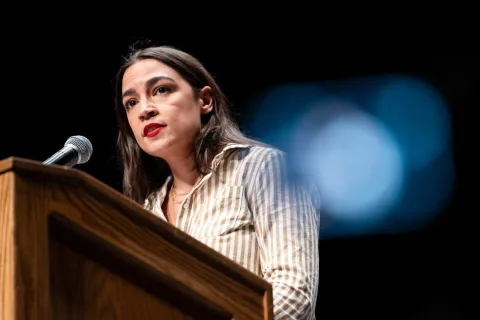
Ocasio-Cortez is also the subject of a separate, narrower contract on whether she announces a run for Senate or president before 2028, a question her 14.6% nomination price does not answer on its own. The two markets measure different things: one her standing in a hypothetical primary field, the other whether she commits to a race at all.
Where the headlines and the market part ways
The Ossoff lead is the sharpest example of the market contradicting the coverage. Several outlets framed the morning after the sweep around Ocasio-Cortez as the clear 2028 frontrunner, with Newsom close behind. The Polymarket contracts tell a different story: Ossoff ahead by double digits, with Newsom and Ocasio-Cortez effectively tied for second. A reelection win in Georgia, a state Democrats cannot take for granted, reads to traders as a stronger 2028 credential than a national profile does.
The same caution applies to the impeachment and Speaker numbers. On all three questions, the live market prices are lower, flatter, or differently ordered than the round figures moving across aggregators and social posts. The lesson for a reader is consistent: the on-platform price, tied to a specific resolution and a specific deadline, is the figure to trust, because it is the one real money is actually committed to.
A Senate still being counted
The Senate was called for Democrats at roughly 54 seats, though several races remained unresolved on November 4 and the final margin was still moving. That margin matters well beyond bragging rights. A larger majority insulates a Democratic agenda from its own defectors, shapes how confirmable the party's nominees are, and feeds directly back into the impeachment math, since conviction in an impeachment trial requires a two-thirds Senate supermajority that even 54 seats does not approach.
That arithmetic is worth stating plainly, because it is where the enthusiasm around the impeachment contracts meets a hard wall. A Democratic House can impeach on a simple majority, which is what the 43% and 62% prices reflect. Removing Trump from office would require 67 Senate votes, a number no plausible 2026 map delivers. The markets that moved are pricing the House action, not a conviction, and the distance between the two is the single most important thing a reader can carry out of these numbers.
What the new map changes for a position
For a trader, the sweep did not close these markets; it repriced the risk inside them and moved the uncertainty downstream. The Speaker contract is now largely a question of timing and party unity rather than outcome. The impeachment contracts have become a calendar trade, where the value sits in which deadline articles actually clear. The 2028 field, by far the deepest of the three, is where the real disagreement lives, and a $1.3 billion market with a three-year horizon has plenty of room left to move as candidates declare or stand down.
The next hard test is close. In January 2027 the new House meets and votes for Speaker on the floor, and Polymarket's 94.3% stops being an estimate and becomes a roll call. If Jeffries takes the gavel on the first ballot, the market was right and the real contest was always the two questions stacked behind it: whether this Congress impeaches, and who it hands the party to in 2028. If he does not, every price on this board resets at once.


